
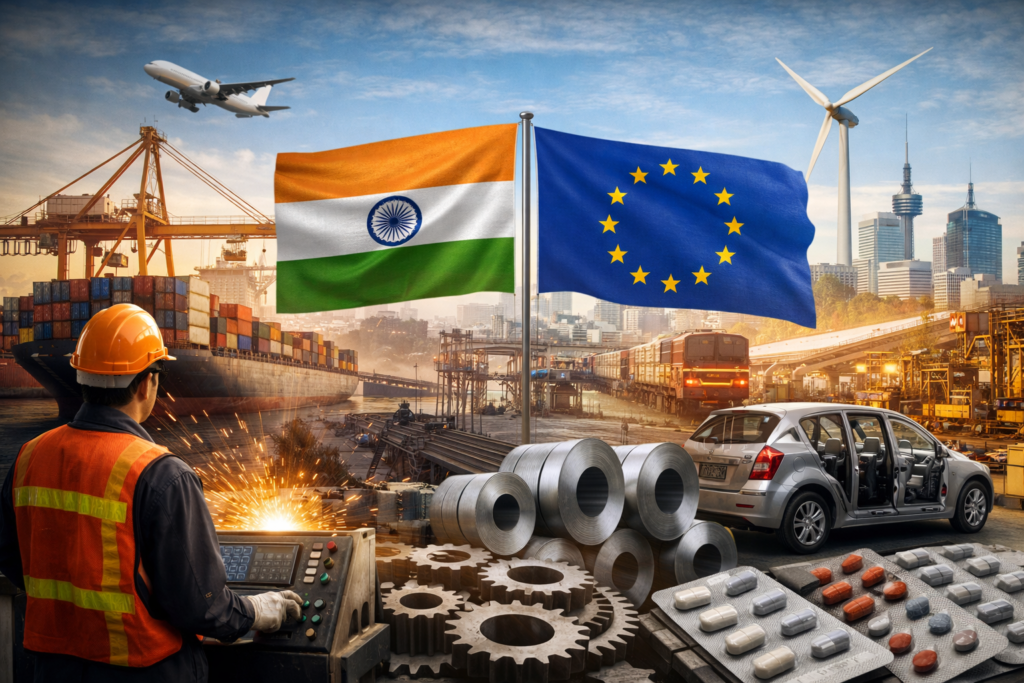
For nearly twenty years, India and the European Union have negotiated a free trade agreement that never quite crossed the finish line. Now, as global trade fractures under tariffs, geopolitics, and supply-chain realignments, the long-pending pact dubbed the “Mother of All Deals” (MOAD) is moving from diplomatic ambition to economic necessity.
Already concluded, the agreement would link India to a bloc representing nearly a quarter of global GDP and one of the world’s most regulation-driven consumer markets. But MOAD is not simply about market access. It means a structural shift in how Indian manufacturing must compete, innovate, and govern itself.
This is not a trade story.
It is an industrial strategy story.
Why the EU Matters in a Fragmented Trade Order
India’s export strategy has long been dependent on a small number of markets. Rising protectionism in the US and strategic decoupling between major economies have made that concentration increasingly risky.
The European Union offers something distinct: a high-income, rules-based market that rewards reliability, compliance, and quality, not just cost. Today, Indian manufacturers face tariffs ranging between 8–14% across textiles, garments, leather goods, auto components, chemicals, and engineering products. Competing exporters from Vietnam and Bangladesh enjoy near-zero duties.
MOAD would gradually erase that disadvantage, restoring price competitiveness. But its more enduring impact lies in forcing Indian firms to align with European regulatory, digital, and sustainability frameworks.
Manufacturing at an Inflection Point
Indian manufacturing has traditionally competed on labour cost and scale rather than value addition. The EU’s procurement ecosystem, however, prioritises traceability, environmental compliance, digital integration, and product certification.
Access to this market will compel Indian firms to modernize their automation and data-driven production systems, quality and regulatory compliance architecture, cleaner energy sourcing, and transparent labor and environmental reporting (ESG).
The transition will be difficult. But it also marks India’s shift from low-margin manufacturing to specification-driven, technology-enabled production. MOAD, in effect, creates an external discipline that domestic reforms alone have struggled to impose.
Innovation Through Integration
Trade agreements increasingly move technology, not just goods. EU companies are global leaders in automotive systems, green manufacturing, industrial machinery, chemicals, and advanced materials. Deeper integration will expand: Joint ventures in high-value manufacturing, Supplier ecosystems around European OEMs, R&D partnerships, Process innovation and Skill upgrading across MSME clusters
This aligns with India’s strategic aim to climb global value chains rather than remain at the assembly stage.
Carbon, Compliance, and the Cost of Access
MOAD also exposes Indian industry to Europe’s climate and regulatory regimes. The EU’s Carbon Border Adjustment Mechanism (CBAM) will impose levies on carbon-intensive imports such as steel, aluminum, cement, and chemicals.
For India, this is both a competitive challenge and a long-term industrial signal. Manufacturing will have to decarbonize faster, adopt energy-efficient technologies, and improve emissions tracking or lose market access.
Smaller firms, in particular, will face adjustment costs. Without policy support in financing, compliance systems, and technology adoption, MOAD risks widening the productivity gap between large corporates and MSMEs.
The Ethical and Strategic Trade-Off
European climate and labor standards raise legitimate equity concerns for developing economies that industrialized later and with fewer resources. Yet global markets are increasingly embedding sustainability into trade rules.
MOAD forces India to confront an unavoidable reality: future competitiveness will be determined not only by cost and scale, but also by governance, transparency, and environmental performance.
A Defining Industrial Moment
MOAD is not simply about exporting more to Europe. It is about repositioning Indian manufacturing for a world where supply chains are shorter, cleaner, and more regulated.
Handled strategically, the deal will:
- Reduce export market concentration risk
- Anchor India into high-value global supply chains
- Accelerate manufacturing innovation
- Push firms up the value curve
The agreement will not transform India overnight. But it could mark the moment when Indian manufacturing stops competing on cost alone and begins competing on capability.
Parikshit Vyas is an Architect-turned Industry and Corporate Strategist with over 26 years of experience across manufacturing, MSMEs, sustainability, supply chains, and corporate strategy. He is also the founder of CORPSKILL.